The Philadelphia Market Doesn't Exist
Numbers in this post reflect the Philadelphia market as of June 2026.
Somebody asks me how the Philadelphia market is doing about four times a week. Usually at a party, usually right after they find out what I do.
And I've stopped giving the honest answer, which is that the question doesn't quite work.
Not because it's a dumb question. It's the obvious question. But "the Philadelphia market" is an average of about a hundred different markets that have almost nothing to do with each other, and the average describes none of them. It's like asking what the weather is in Pennsylvania.
Here's what I mean.
The citywide numbers, and what they're actually good for
At a city level right now, a few things are true.
Sales volume is down and has been for four straight years. We're pacing toward roughly thirteen thousand four hundred sales. In 2021 that number was north of twenty thousand.
Prices are holding. Median around $290,000, up from $275,000 a year ago.
Inventory is up modestly, months of supply has stretched a bit, and we're still in what most people would call a balanced to slightly slow market rather than anything dramatic.
That's useful information. It tells you the direction things are moving. It tells you nobody should expect a 2021 bidding war and nobody should expect a crash either. If you're deciding whether this is a reasonable year to make a move at all, citywide is the right altitude.
What it will not tell you is what your house is worth. Not even close.
The split inside the average
Here's the number that actually matters, and it's one most people never see.
Homes that sold recently went in a median of about seventeen days. Homes currently sitting on the market have been there past fifty.
Same city. Same month. Same buyers.
Roughly forty-four percent of active listings have already cut their price at least once.
So when someone says the market is slow, what they usually mean is that they know somebody whose house is sitting. And when someone says the market is hot, they know somebody who got three offers in a weekend. Both are describing something real. Neither is describing the market, because there isn't one.
There are houses priced where the market is, and they're moving fast. There are houses priced where the seller hoped the market was, and they're not moving at all. The average of those two things is a number that describes no actual house.
Neighborhood is where value lives
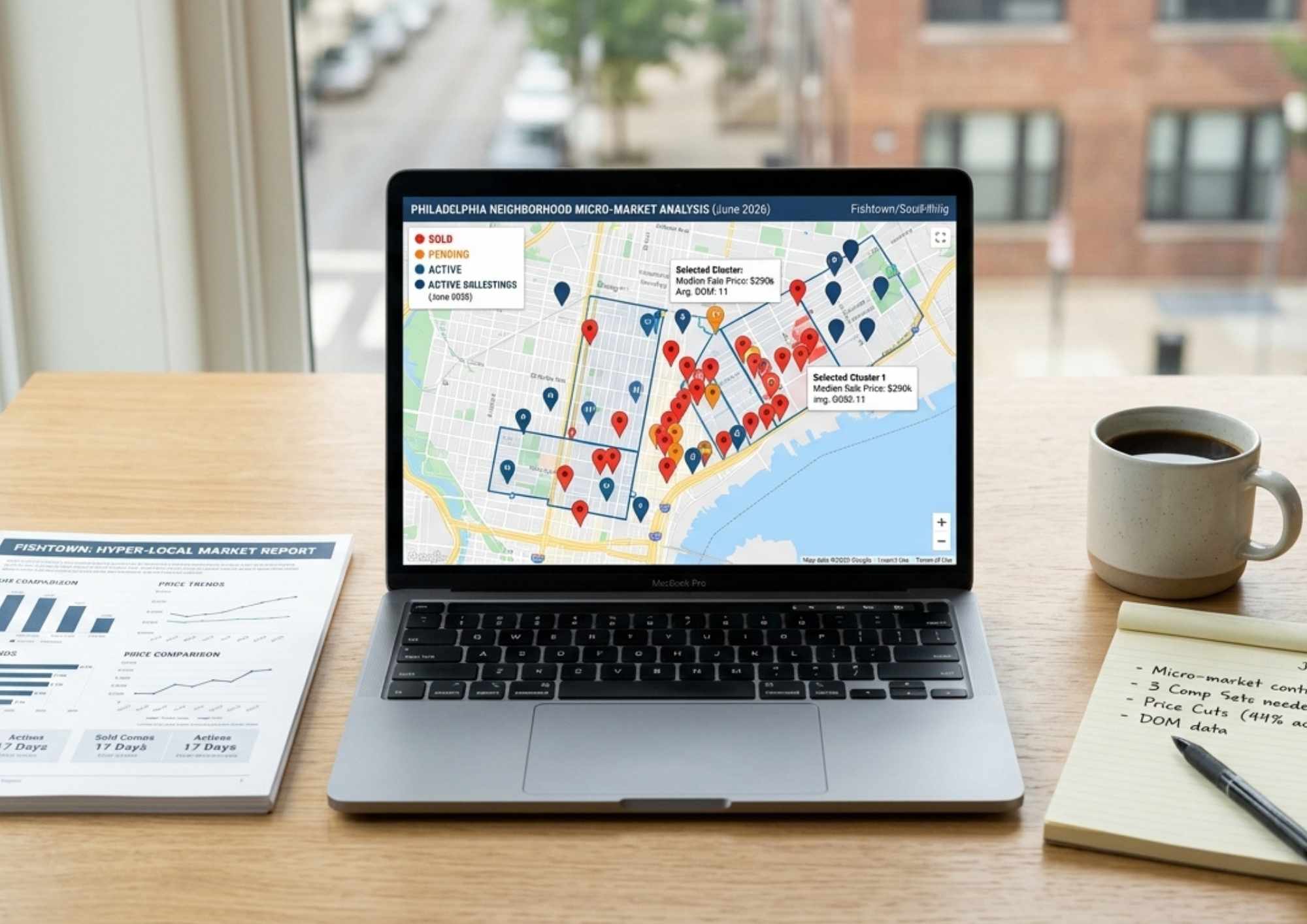
Take Fishtown. Homes selling there recently have been going in about eleven days. Active listings sitting there are past forty.
Now go one mile in almost any direction and the numbers change materially. Different buyer pool, different price band, different inventory, different amount of new construction competing with resale.
This is why I get uncomfortable when a seller tells me what they saw on a national real estate site. Those estimates are built on broad models, and broad models handle a city like Philadelphia badly, because we have blocks that behave differently from the block behind them. Corner versus mid-block. Which side of the avenue. Whether the elementary catchment changed. Whether four new construction units went up two streets over and reset what a buyer thinks a certain price should get them.
There is no algorithm that knows the difference between two streets in Point Breeze. There are people who do.
How to actually use this
If you're a seller, here's the practical version.
Citywide data tells you whether it's a reasonable time to sell. Neighborhood data tells you what to ask. Don't mix them up, and be suspicious of anyone who gives you a price using only one of them.
Ask for three comp sets, not one. Sold tells you what buyers already paid. Pending tells you what's happening right now, which is the most current information available and the set most sellers never get shown. Active tells you who you're actually competing against, which matters more than people expect, because a buyer is going to look at your house in a tab right next to three others.
And when you're looking at active listings in your neighborhood, look at how long they've been there. A neighbor asking a big number is only useful information if the house is selling. If it's been sitting ninety days, that's not a comp. That's a cautionary tale with a sign in front of it.
If you're a buyer, the same split works in your favor. In a market where half the active listings have already been reduced, the houses sitting past sixty days are a different negotiation than the ones that just hit. Knowing which is which by neighborhood is most of the job.
The short version
The citywide number tells you the direction of the market.
The neighborhood tells you the value of the house.
Anyone who answers "how's the market" with a single number for a city of a hundred neighborhoods is telling you what they know, and it isn't much.
If you own in Philadelphia and you're curious where your specific neighborhood actually stands, I'll pull it for you. What's selling, what's sitting, how long it's taking, and what's already been reduced on your few blocks. Not the citywide average.
No obligation, and it doesn't mean you're selling. Most of the people I do this for aren't.
Book a Time or Call/text me at 215.287.4299.
